
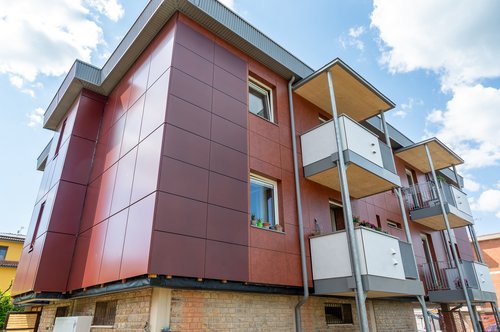
This demo case consists of the innovative renovation of two twin residential buildings. One building is being upgraded with advanced INFINITE prefabricated facades, while the other uses traditional methods. This comparison aims to evaluate life cycle costs, life cycle assessments, installation time, user feedback, consumption, and performance. The prefabricated approach includes high-performance facade panels, a new lightweight wooden roof with integrated BIPV tiles, and prefabricated balconies with embedded ventilation units. The renovation also incorporates glass-glass colored BIPV panels, BIST cladding, and smart glazing windows. Extensive monitoring pre- and post-renovation provide detailed data on the efficiency and effectiveness of the prefabricated solutions.
January 16, 2026
Renovated two storey building in Tuscany
Italy

The property in southwest Terrassa, between Olesa and Martorell roads, occupies an irregular plot with a U-shaped building around a courtyard. It includes two residential blocks (East and Northwest) and a commercial space not part of the renovation project.Each block has three floors plus an attic, with separate entrances, stairs, and elevators, totalling 32 homes. Two basement levels link both blocks, used for parking and storage.Built in 2008 but never finished, the 4,504 m² complex suffered damage from abandonment. AHC acquired it to complete works and dedicate 1,280 m² of the East block to social housing.
January 16, 2026
Terrassa Barcelona
Spain
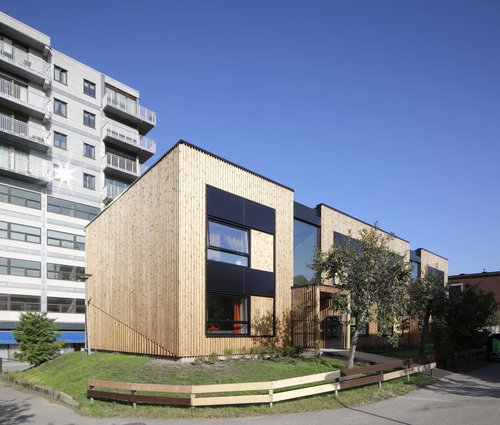
The retrofit project involves a small multi-family building (2 storeys) and 8 apartments, built in 1975. The envelope, façade and roof, has been entirely retrofitted.The building’s façade has been renovated using prefabricated modules with integrated high-performance technologies. The approach minimized disruption for residents by enabling work to be completed within a very tight timeframe. The renovation was carried out as part of the European project H2020 4RinEU.
January 16, 2026
Haugerudtunet Oslo
Norway
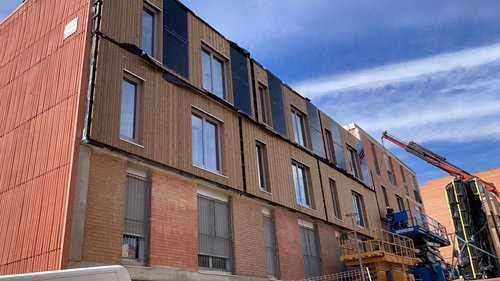
Multi-family social housing building divided in two blocks due to terrain topography, with 15 apartments total (5 per floor across 3 residential levels plus basement garage).The main façade is east oriented, with unique entrance, while the west façade features open common corridors.The building underwent deep renovation with timber prefabricated multifunctional façade (PMF) on 1st and 2nd floors of east façade, integrating PV panels, ventilation systems, and new balconies.The U-value of the existing façade amounted to 0.64 W/m²K before renovation.After renovation, significant gains were observed:Ground Floor: 0.37 W/m²K (with conventional ETICS)1st-2nd Floor: 0.16 W/m²K (with PMF panels - Prefabricated + Existing wall)
January 16, 2026
Coma del Forn
Spain
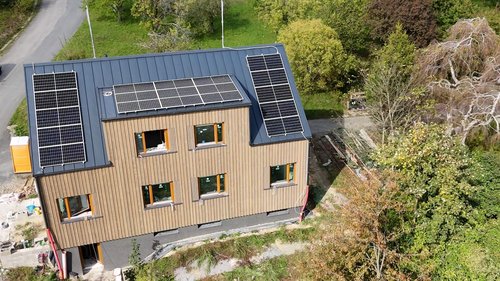
The building dates back to the 1946–1950, and consists of two floors with one flat each and a cellar/garage underground.The building area totals 287 m² (193.5 m² floor area + 93.5 m² underground). The 1st-floor flat is 81.2 m², the 2nd-floor flat 50 m² + 8.8 m² balcony.The building is built with brick walls, Hurdis ceilings, wooden purlin roof with sheet metal, no wall insulation, plastic windows (2013), and ceramic/wood flooring.
January 16, 2026
Kasava Building Retrofit
Czech Republic

The site once hosted Voula’s aqueduct, active from WWII’s end until the mid-1960s, when the municipality connected to Athens’ main water network (EIDAP). The old aqueduct buildings were demolished, and the land was sold to the Kalogeratou family, who built three apartments in 1971. In 2010, the property was donated to the VVV Municipality, which now uses it to house elderly residents and low-income families. Maintenance has been handled by the Technical Department, though limited funding during Greece’s 2010–2019 crisis caused structural and system deterioration. The building has reinforced concrete foundations, frame, floors, and roof, brick masonry walls, balconies, cement plaster finishes, mixed wood and aluminum openings, and minimal insulation.
January 16, 2026
Voula Renovated Building in Athens
Greece